Applied ML & Deep Learning
Choose and evaluate models, then understand training and pretrained inference. Start with applied ML, then move on to deep learning.

Compare models
Use baselines, suitable metrics, and reproducible evaluation.
Understand training
Run and debug a PyTorch training loop.
Use pretrained models
Run inference and explain model behavior and limitations.
Applied ML and evaluation
choose and assess models using evidence.
Before you start: Engineering Fundamentals data manipulation, statistics, and linear algebra; begin Software Engineering for AI alongside this module.
Learn
- Supervised regression and classification; linear/logistic models, trees, random forests, and SVM intuition.
- Preprocessing and a reproducible scikit-learn pipeline.
- Baselines, train/validation/test splits, cross-validation, and data leakage.
- Classification metrics: precision, recall, F1, confusion matrix, ROC-AUC, and precision–recall evaluation. Choose metrics based on the task.
- Regression metrics at an introductory level; overfitting, underfitting, and error analysis.
Resources
IBM: What is machine learning?
Required. Introductory overview of learning, inference, and generalization.

StatQuest: Linear Regression and Linear Models
Required. Study the introductory linear-regression and multiple-regression videos. Focus on model assumptions and predictions, then implement a model.

StatQuest: Logistic Regression
Required. Study the main ideas and the relationship between scores, probabilities, and classification. Detailed derivations are supporting material.
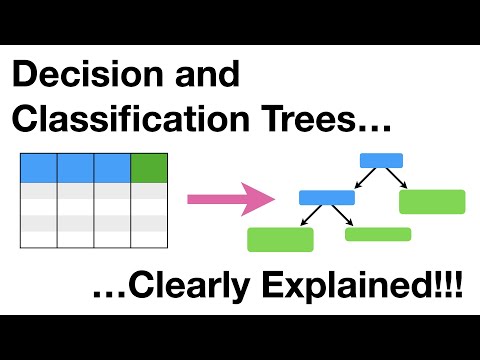
StatQuest: Decision and Classification Trees
Required. Study split decisions and predictions, then train and evaluate a tree.

StatQuest: Random Forests
Required. Study building, using, and evaluating a random forest, then compare it with a baseline.
See the StatQuest topic index for additional supporting videos.

StatQuest: Support Vector Machines
Required. Study the decision-boundary and margin intuition. Detailed derivations are supporting material.

Model Evaluation Metrics
Required. Use the classification section as a companion reference. Use official scikit-learn documentation for implementation.

scikit-learn: Getting Started
Required. For estimators, preprocessing, pipelines, and evaluation.
scikit-learn: Common pitfalls
Required. Study inconsistent preprocessing and data leakage.
Practice
- Choose a small public dataset or a built-in scikit-learn dataset; define the target and a task-appropriate metric.
- Create a baseline and compare at least two candidate models using the same split and preprocessing rules.
- Inspect mistakes and explain a useful improvement. Keep final test data out of model and preprocessing selection.
- Run a small regression example if your main exercise is classification, or a classification example if your main exercise is regression.
Expected output
A reproducible modeling notebook or script, a results comparison, and a short error-analysis note. You can justify the split, baseline, metric, and model choice, and identify a leakage risk.
Deep learning and pretrained models
understand a training loop and use a pretrained model deliberately.
Before you start: applied ML, NumPy, and matrix operations.
Learn
- Weights, activations, losses, gradient descent, and forward/backward propagation.
- Tensors, shapes, broadcasting, autograd, nn.Module, and train/evaluation modes.
- Write a small training loop, diagnose training failures, and save/reload model weights.
- Distinguish training, pretrained inference, and fine-tuning. Develop an introductory transformer mental model.
Resources

Andrew Ng: Neural-network foundations
Required. Study neurons, forward/backward propagation, loss, and gradient descent; use the relevant Course 1 and Course 2 sections rather than completing both courses in full.

CS231n Winter 2016 lectures
Required. Lectures 2, 3, and 4 on classification, optimization, and backpropagation. Use them to reinforce gaps identified during implementation.
UvA Tutorial 2: Introduction to PyTorch
Required. Use this as the main practical anchor. Run the notebook, then change its data or network and explain the changes.

Hugging Face LLM Course: Transformer models
Required. Selected introductory sections on pipelines and transformer architectures. Run a pretrained inference example.
Khan Academy differential calculus
Further reading. A quick refresher if gradients or backpropagation feel unfamiliar: derivative intuition, the chain rule, and what a gradient tells you. Not required for this module.
Practice
- Train a small neural network on a manageable dataset and plot training and validation behavior.
- Create one controlled training failure, such as an unsuitable learning rate or a shape mismatch, then diagnose and repair it.
- Save the weights, reload them in a separate inference script, and verify the output.
- Use a pretrained model for a task and explain the model's inputs, outputs, and limitations.
Expected output
A small training implementation, a saved model, a separate inference example, and a debugging note. You can explain each part of the training loop and distinguish model learning from inference.
Workload
Use the provisional estimates where supplied. Other workloads remain pending pilot. Include implementation, debugging, review, and revision.
Finish this module
Keep the required outputs and explain your decisions. Diagnose a relevant failure during review and revise incomplete evidence after feedback. Resource completion supports progress; the stated practical requirements determine completion.